
The procedure explained from A to Z
Thanks to our use of technology, expertise, and clear communication, the inspection process runs smoothly and efficiently. After the inspection, you’ll receive immediate feedback on the findings, even before the official report is drafted. This way, you’ll know exactly where you stand. Within 20 business days of the inspection, you’ll receive the inspection report, which clearly and concisely summarizes all findings.
Our Approach
From design review to certification, our experts handle the entire inspection process to ensure certified fire safety. By conducting the initial inspection, interim inspections, and follow-up inspections, projects can proceed smoothly. Watch the video to see
How We Work
An inspection certificate in 8 steps
-
1.
Basic Design Review
The client submits the basic and detailed designs. We begin with an initial assessment of the basic design, which consists of the Statement of Requirements (SOR) or the Design Basis Document (DBD) for the installation. This is an administrative review in which we determine whether the content of the basic design is complete and meets the derived objective(s). View here to see exactly which documents are required.
-
2.
Detailed Design Review
Next, we review whether the detailed design of the fire protection system complies with the principles established in the basic design. The detailed design consists of the drawings, calculations, diagrams, and other detailed specifications of the system. The inspector assesses whether this information ultimately results in a fire protection system that meets the (required) objectives. See here to see exactly which documents are required.
-
3.
Preparing the Inspection Plan
Prior to the on-site inspection, the inspector draws up the inspection plan. This plan describes the scope and content of the inspection. It also lists the inspection points and criteria based on which the fire protection system will be approved or rejected. The inspector then sends the client a confirmation of the appointment for the inspection to be conducted.
-
4.
On-site inspection
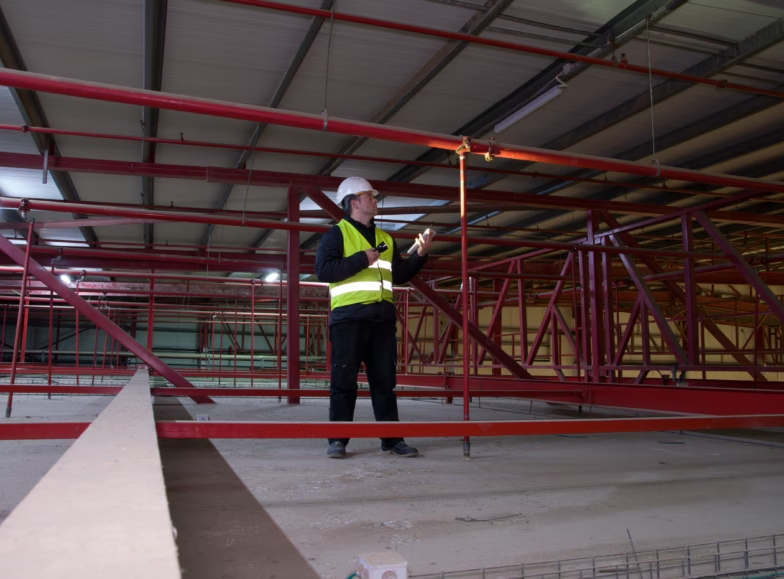
On the agreed-upon inspection date, the inspector arrives on site. The inspection consists of administrative, visual, and functional assessments and always begins with a brief preliminary discussion explaining these components. Is the measurement and testing equipment available? If so, the inspector can get started right away. View here to see exactly which documents are required for the administrative observations.
-
5.
Post-inspection debriefing
Is the inspection complete? A debriefing with the client follows immediately. The inspector shares the initial findings. Of course, everything is also documented in an inspection report that includes a conclusion and supporting rationale.
-
6.
Preparing the inspection report
After the inspection, the inspector prepares the inspection report, which includes his findings, a conclusion, and supporting rationale. If it appears that the fire protection system does not yet fully meet the objectives, the report will further explain where the system needs to be improved. A fellow inspector reviews the inspection report in accordance with the four-eyes principle.
-
7.
Everything in order?
If, following the inspection, it turns out that all components are in order and the fire protection system meets the specified requirements and objective(s), the inspection certificate can be issued. We send the inspection report and inspection certificate to the client.
-
8.
Inspection Certificate
An inspection certificate is required to demonstrate that your building is fire-safe. During the inspection, the systems, structural features, and organizational measures are assessed. If all these aspects are in order, you will receive an inspection certificate from us. This certificate allows you to demonstrate to your insurer, among others, that your fire protection system meets the requirements.
Inspection Methodology
Various inspection methods are available for inspecting fire protection systems. We can determine compliance with specific standards or with reference documents. We can also conduct inspections based on derived objectives in accordance with the CCV inspection schedule. Ultimately, the client decides which method we should use for the inspection. This choice depends on the purpose of the inspection.
Does compliance with the Building and Living Environment Decree (Bbl) need to be ensured? In that case, an inspection based on derived objectives according to the CCV inspection schedule will be chosen.
CCV Inspection Scheme
The Center for Crime Prevention and Safety (CCV) is an independent scheme administrator that develops and manages certification and inspection schemes for fire safety. The CCV inspection schedules describe the requirements that a fire safety inspection of a building must meet. The assessment may take place during the basic design phase (e.g., program of requirements), the detailed design phase, after the system has been commissioned (initial inspection), or during the operational phase (follow-up inspection). An assessment is made to determine whether the fire protection system can achieve the objective set forth in the guiding principles.
Accreditation
Inspection activities based on the CCV schemes are conducted under accreditation for fire alarm, evacuation alarm, sprinkler, fire suppression gas, fire suppression foam, water spray, water mist, and smoke control systems. During the inspection, the system is checked and the associated controls are tested; structural and organizational aspects—such as system management and storage—are also examined. The specific inspection points can be found in the CCV inspection checklist. Based on this inspection, we prepare an inspection report. If an inspection has been conducted and a positive conclusion can be reached regarding the objective, an inspection certificate may be issued.
If, for example, the installation falls under PGS15, the competent authority may impose additional requirements. The method must then be adapted to meet the requirements of the competent authority. When we are required to conduct a spot-check inspection for an installer in accordance with a certification scheme, compliance with certain standards must be verified.
In short, it is important to clarify in advance the purpose of an inspection to avoid any future issues with meeting the specified requirements.
Installation or Maintenance Certificate
If an installation is accompanied by an installation or maintenance certificate in accordance with the CCV certification scheme, the inspection of that part of the installation will be less thorough. Therefore, it must already be clear at the time of the request whether or not an installation or maintenance certificate will be provided.
The CCV video explains the inspection steps in great detail.