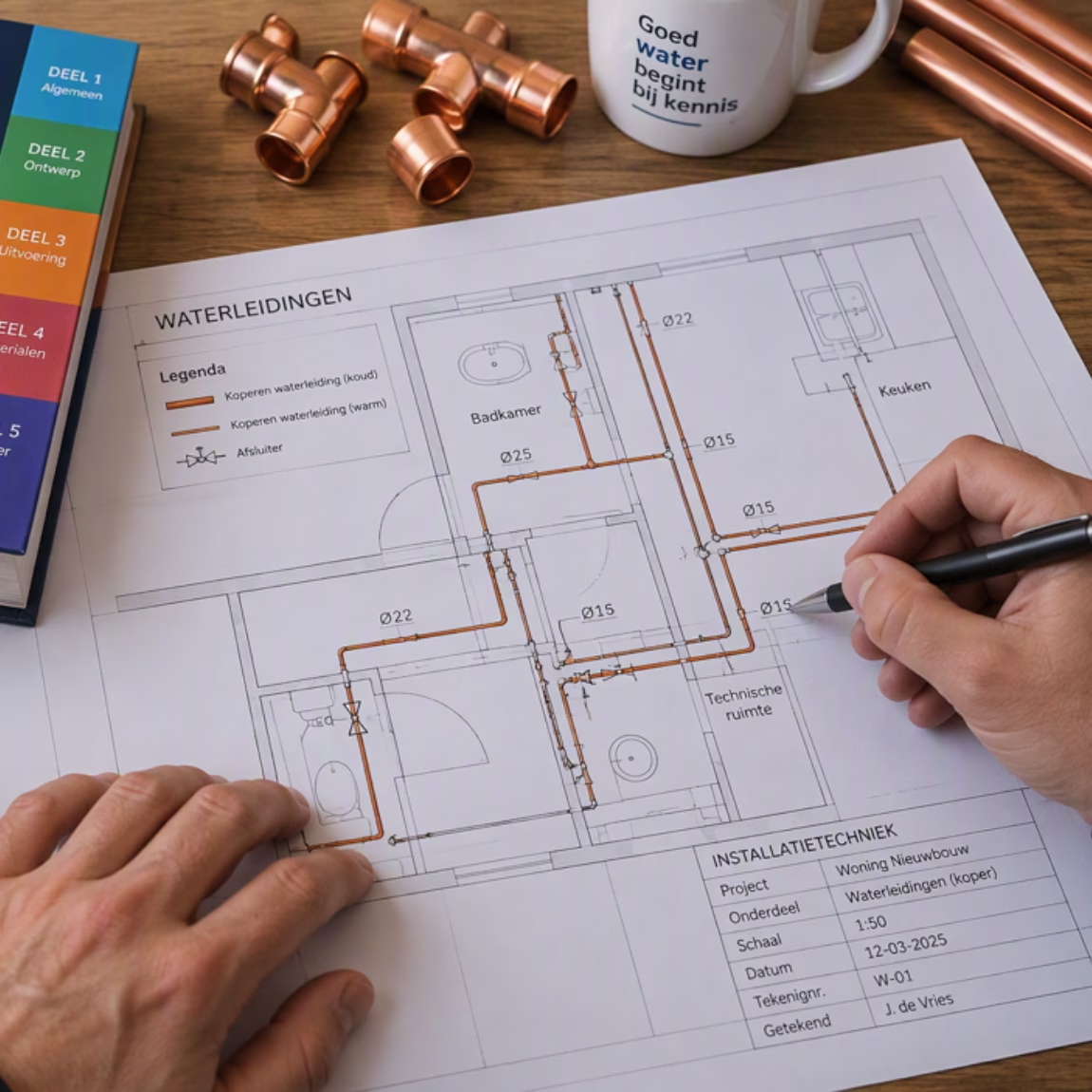
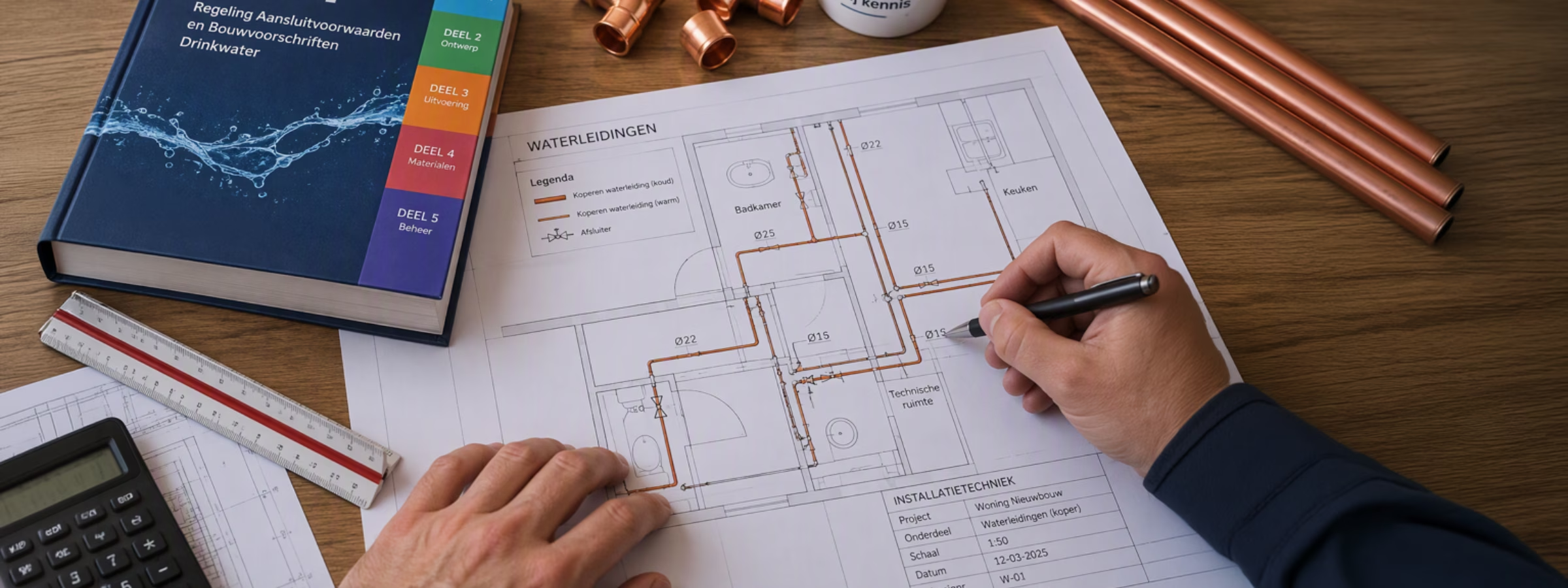
A risk analysis, management plan, source investigation, or check valve inspection may lead to a recommendation to make a technical modification to the drinking water system.
But what exactly does such a recommendation mean? And why can a technical modification be important for a safe and easily manageable drinking water system?
Does your drinking water system need a technical modification?
With a technical inspection, we assess the situation and provide you with clarity on any areas for improvement.
Why do technical modifications result from an inspection?
In a risk analysis and management plan (RABP) in accordance with BRL 6010, we don’t just look at the current management of the drinking water system. We also identify technical conditions that could cause or increase a risk.
Examples include:
- an unused pipe in which water remains stagnant;
- a pipe that is too long leading to a tap, such as a mixing pipe that is too long;
- insufficient circulation of hot tap water;
- hot water that does not reach the correct temperature of 60 °C;
- hot water in a supply pipe that, due to insulation, does not cool down to 25 °C or lower within 45 minutes;
- unwanted heating of cold water;
- a technical situation that is difficult to manage effectively.
In these situations, the recommendation may be to make technical modifications to the system. This approach focuses not only on managing a risk but also on addressing its root cause.
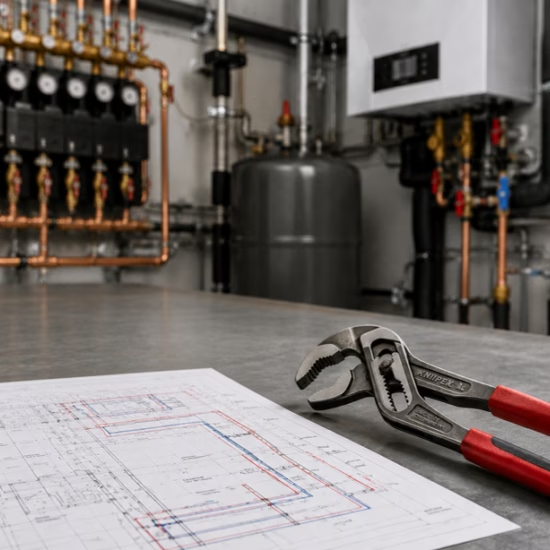
A technical modification addresses the root cause
An important advantage of a technical modification is that it is often structural.
Suppose there is an unused pipe. Flushing this pipe regularly controls the risk. However, the unused pipe remains part of the system.
By actually removing the pipe, you address the root cause of the problem. The control measure for that pipe or tap can then also be discontinued.
This is how you move from temporary control to structural improvement.
Ultimately, this may mean fewer additional control measures are needed. As a result, not only costs but also energy and water can be saved in the long term.
Examples of technical modifications
Depending on the situation, a report may recommend various technical modifications. For example:
- Removing a dead pipe
An unused pipe is removed to prevent stagnant water in the system. - Shorten a pipe
A long pipe leading to a faucet is shortened to limit the water’s residence time. - Adjusting hot water circulation
Circulation is improved or re-adjusted so that hot water flows properly through the system. Better adjustment can also make the system more energy-efficient. In certain situations, this can result in significant savings.
Consider, for example, a hot water system where the outlet temperature can be safely adjusted from 75 °C to 63 °C. Depending on the specific system, this can result in savings of more than €1,000. - Protecting Cold-Water Pipes from Heating
A pipe is rerouted or insulated when unwanted heating of the cold water poses a risk. - Removing an unused faucet
A faucet that is no longer in use is removed along with the corresponding section of pipe. - Removing insulation from hot water supply lines
Removing insulation from hot outlet pipes allows the pipe to cool to below 25 °C within 45 minutes. - Installing or relocating appliance protection
Where necessary, the required appliance safety device is installed or relocated to ensure the drinking water system complies with technical standards.
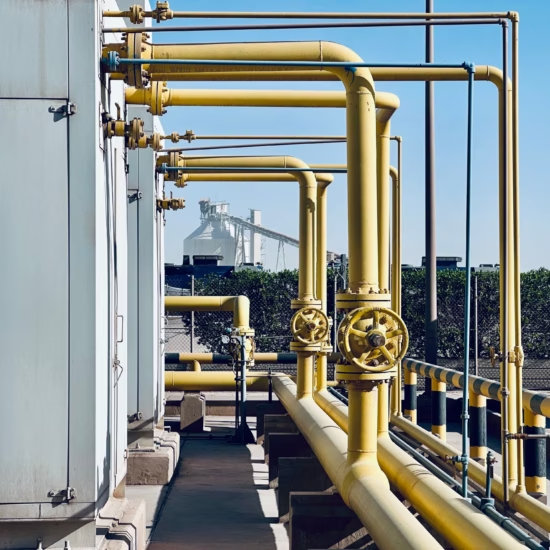
A check valve inspection may also result in a technical modification
During a check valve inspection , we verify whether a check valve is still functioning properly and is suitable for its intended use.
A check valve plays an important role in the drinking water system: it helps prevent contaminated water from flowing back in an undesirable direction.
If a check valve no longer functions properly, is damaged, or no longer meets the required standards, we may recommend replacing it.
Here, too, an inspection is more than just a snapshot. It provides the opportunity to identify areas for improvement in a timely manner and to keep the system in good technical condition.
Why not just keep inspecting it?
Periodic inspection and maintenance remain important. But when a technical problem is persistent, simply continuing to inspect is not always the best solution.
A good approach therefore consists of five steps:
- Identify the risk or deviation
↓ - Investigate the cause
↓ - Implement technical adjustments where necessary
↓ - Manage residual risk
↓ - Continue to monitor periodically
In this way, technology and management reinforce each other. You not only manage the existing risks but also identify opportunities for structural improvements.
What does this mean for you?
If a BRL 6010 report or check valve inspection indicates the need for a technical adjustment, this does not automatically mean that there is something seriously wrong with your system.
It means that an area for improvement has been identified that can further enhance the water quality, reliability, and manageability of the drinking water system.
We’ll help you translate the technical advice into a concrete and practical solution. In doing so, we’ll work together to address three questions:
- What needs to be done?
- Why is this adjustment necessary?
- How can we implement this in practice?
This way, you’ll know what’s needed to keep your drinking water system safe and well-managed.
Need advice on a technical modification?
Have you received technical advice following a risk analysis, management plan, or check valve inspection, and would you like to know what this means in practice?
Feel free to contact us. We’d be happy to work with you to find a suitable technical solution.
Frequently Asked Questions About Technical Modifications
-
No. A risk analysis can identify areas for improvement, but that does not automatically mean that a technical modification is necessary. This depends on the situation, the identified risk, and the options available to effectively manage that risk.
-
A technical modification allows you to address the root cause of a problem in a structural way wherever possible. This can eliminate the need for certain management measures and lead to long-term savings in management, water, and energy costs.
-
This may become apparent, for example, following an inspection, investigation, or technical assessment. Changes to the building or the use of the system may also necessitate modifications.
-
The work required depends on the system and the identified issue. Normec carries out the technical modifications necessary to improve water systems in buildings.