Accessibility links Skip to main content

How harmful is lead in drinking water, and what can you do about it?

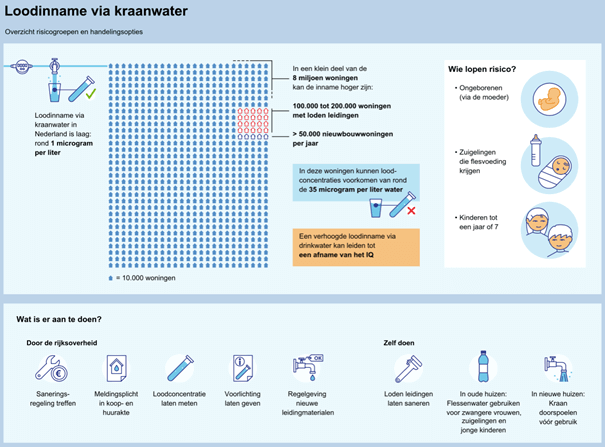
Homes built before 1960 may still have lead pipes. In the Netherlands, there are still between 100,000 and 200,000 homes with lead pipes (Health Council Report, Nov. 2019). This can cause lead to enter your drinking water. Even with new pipes in newly built homes, lead can temporarily end up in the drinking water. These lead particles are harmful to health, especially for pregnant women and young children. Just how harmful is lead, and what can you do about it?

Continue reading
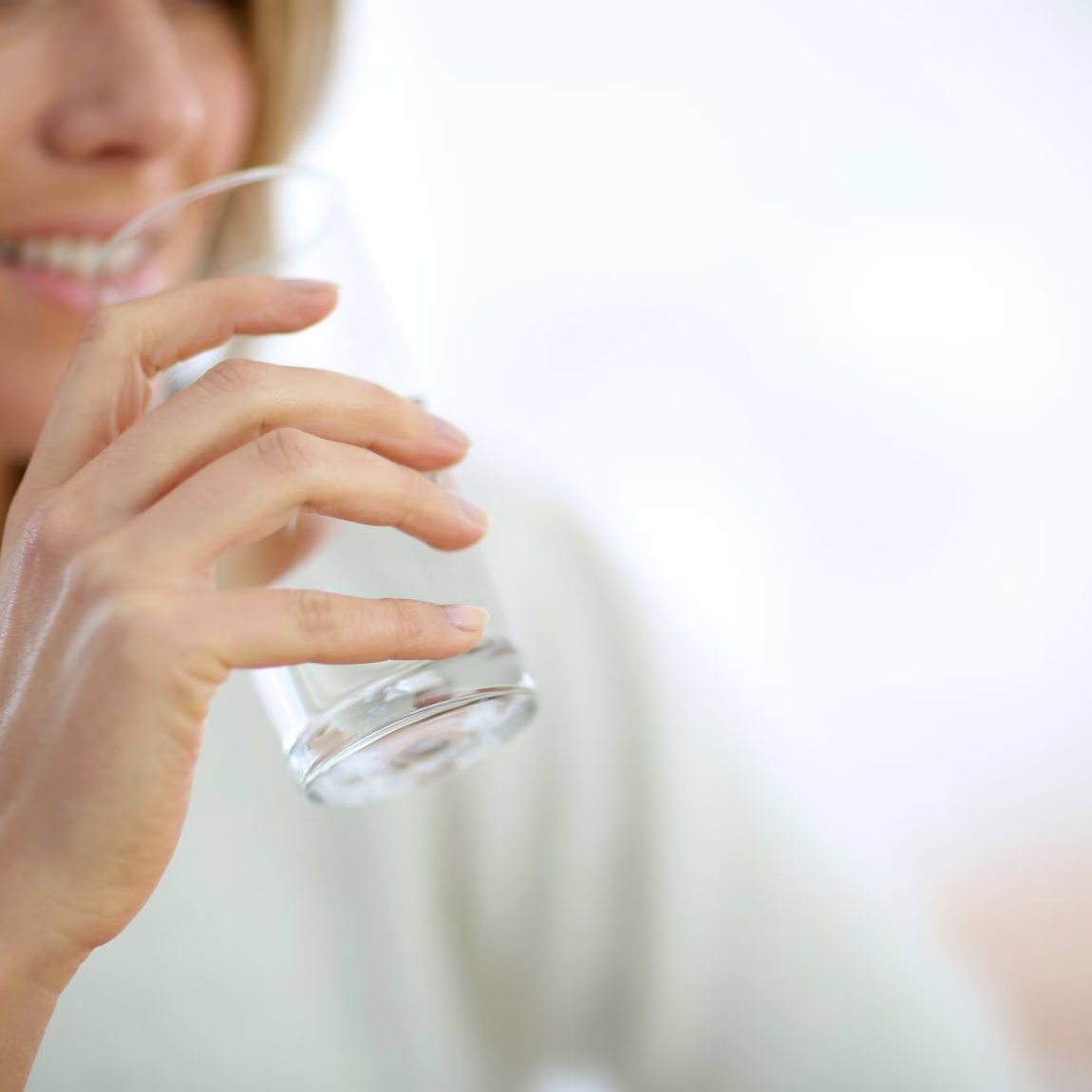
A person drinks a glass of water in a well-lit indoor setting.

The Hazards of Lead in Drinking Water

Lead is a heavy metal, and if you have lead pipes in your home, you may ingest a small amount of lead through your drinking water. Research shows that excessive lead exposure can negatively affect the development of the brain and nervous system in unborn babies and young children up to age 7. It can lead to a slightly lower IQ and behavioral changes. Bottle-fed infants are particularly at risk.

The World Health Organization (WHO) therefore recommended in 2000 that the standard for lead in drinking water be tightened to 10 micrograms per liter of water. If lead water pipes are present, the drinking water may exceed that standard.

Replacing Lead Pipes

It is therefore important to replace lead pipes as soon as possible. If that is not feasible, reroute them. Is replacement or rerouting too expensive or complex? In any case, make sure to replace the pipe leading to the kitchen faucet; after all, this is the place in the home where water is primarily used as drinking water.

You can easily recognize lead pipes by their dull-gray color and the dull sound they make when you tap them with, for example, a spoon.
Loodinname via kraanwater

Source: Health Council of the Netherlands Advisory Report, November 2019

Bottled Water and Flushing

Until your lead pipes are replaced, pregnant women and children up to age 8 should use bottled water. Also, use only bottled water instead of tap water when preparing formula. Boiling water is ineffective and does not remove lead particles. In addition, it is recommended to let the tap run for 2 minutes in the morning before using the water for the first time. However, it is unclear how effective this flushing recommendation is.

Do you have a newly built home or new water pipes? In that case as well, the recommendation is to let the tap run for a few minutes before using the water as drinking water for the first 3 months.

More information?
Health Council of the Netherlands Advisory Opinion, November 2019
Frequently Asked Questions about Lead in Drinking Water, Amsterdam Municipal Health Service (GGD Amsterdam)
Information on lead in drinking water from the RIVM

Looking for an independent inspection partner?

Normec offers expert and independent inspections to ensure the safety of buildings, installations, and facilities.

Contact us

Complete the form and we will contact you as soon as possible.
Naam
Privacy Policy 

Request a quote

Fill out the form and we will contact you shortly.

Naam
Privacy Policy 

Related Articles

20 Jul 2026

Why Water Quality Is Crucial for Your Central Heating System

In building management, water quality plays a crucial role in the proper functioning of systems. Water is the foundation of every central heating system and directly affects comfort, performance, and operational continuity. If the water composition is not optimal, scale, corrosion, and contamination can occur. This leads to higher costs and increased maintenance.

Laboratory glassware, including measuring cups, pipettes, and test tubes, submerged in water and visible in a testing or analytical setting.
29 Apr 2026

Proposed Legislative Amendment on Legionella: What’s Happening and What Can You Expect?

The rules for Legionella prevention may change. Here’s what we know so far. A development is underway in Legionella prevention that may lead to changes in legislation. This process has been ongoing for about five years and is based on evolving scientific insights. One of the potential major changes is a shift in focus from broad-based Legionella sampling to a more targeted approach focused on Legionella pneumophila. Understandably, this raises questions. What direction is this heading in, and what might this mean for organizations working to ensure safe water? At Normec Aquaserva & Kalsbeek, we are closely monitoring these developments. In this article, we share the most important insights currently available.

A faucet with running water above a sink in a bathroom.
22 Jun 2021

Detecting lead water pipes

Due to the COVID-19 crisis, public health is currently the single most important issue facing the world. Various organizations are focusing on the importance of health both during and after the further easing of the lockdown. We, as a consulting firm, are also actively engaged in this effort—particularly in ensuring the safe use of buildings and water systems. After all, safe and healthy drinking water is also essential for good health.

Aerial view of an industrial water treatment plant located on the waterfront.
19 May 2021

RIVM on the water treatment plant

Wastewater treatment plants can spread Legionella bacteria through the air, potentially causing people in the surrounding area to inhale the dangerous bacteria. To prevent this, measures must be taken, the National Institute for Public Health and the Environment (RIVM) reported Tuesday, citing two new studies.

A person in a lab coat is recording measurement data on a form next to laboratory equipment.
21 Jun 2021

Focus of the SZW Inspection 2021: Healthy and Safe Working Conditions

In 2021, working safely and healthily is more important than ever. The COVID-19 crisis has made this abundantly clear. To reinforce this, the SZW Inspectorate will once again focus on compliance with core occupational health and safety obligations in 2021. Through active inspections, the Inspectorate will remind employers of the importance of properly implementing the Risk Inventory and Evaluation (RI&E), the action plan, and the basic contract as the foundation for a safe and healthy work environment.

An empty swimming pool in which the lane lines on the bottom are clearly visible.
26 Apr 2021

Safe Swimming Waters and the New Environment Act

With the implementation of the new Environment Act, pool owners will face changes and new rules in swimming water regulations. Many detailed regulations are being phased out. As a result, you, as a pool owner, will have more room for ideas and innovations, as well as greater freedom of choice in your approach.

Related services

Two employees are inspecting an industrial facility and recording inspection data using a tablet.

Water Safety and Compliance

A water sample is collected from a faucet for water quality analysis.

Water Quality & Testing

A technician is performing inspection and maintenance work on a water treatment plant equipped with piping and filter tanks.

Water Treatment and Systems

A water sample is examined in the laboratory to analyze water quality and microbiological parameters.

Monitoring and Management