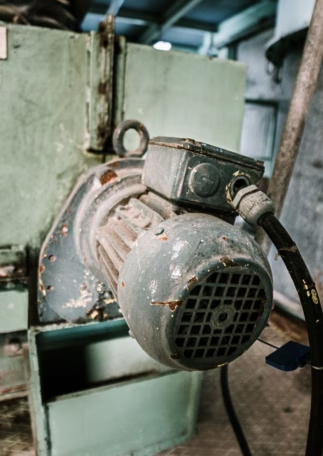
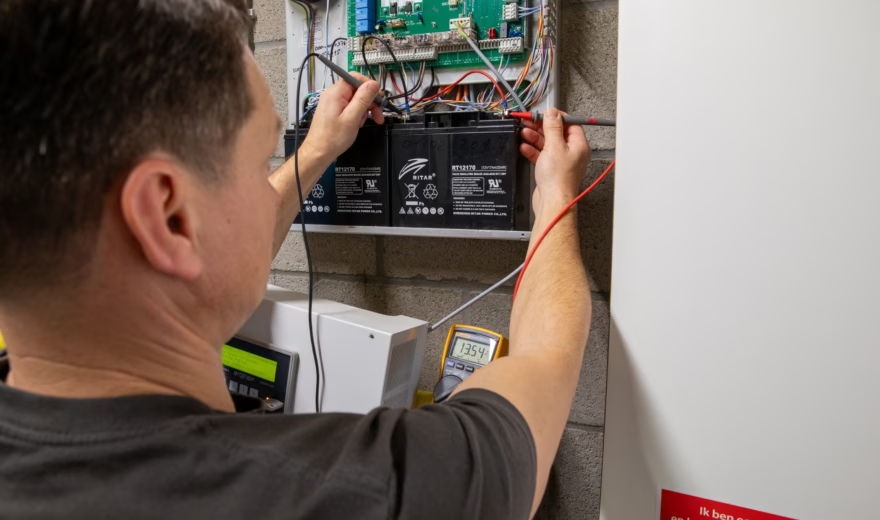
More than 50 percent of Germany’s electricity consumption goes toward powering electric motors. There are a wide variety of motor types. Most electric motors that run on standard 230-volt AC power from a wall outlet are so-called capacitor motors. When such a capacitor motor malfunctions, the component that gives it its name is often to blame. It’s therefore a good idea to inspect the electric motor’s capacitor. In this blog post, we’ll explain how professionals go about inspecting a motor capacitor. We’ll cover other possible causes in our article titled“Electric Motor Won’t Start.”
The good news is that capacitors are easy to replace and generally not too expensive. They are considered wear-and-tear parts with a limited service life. With a new capacitor, the electric motor will often run without any problems for a long time to come. To find out whether this relatively inexpensive component is actually to blame for a malfunction, let’s now test the motor capacitor.
Warning! Under no circumstances shouldthe following work be performed by non-professionals.
Where can I find the motor capacitor?
The motor capacitor—or, in heavy machinery, multiple capacitors—is usually located on the outside of the electric motor under its own metal cover. Before opening the cover, you should take the necessary safety precautions—as always when working with electricity. This means: Disconnect the device from the power supply by unplugging it, flipping the power switch to the “off” position, or removing the appropriate fuse. It’s best not to remove the cover with wet hands or in a damp environment. Additionally, it’s always advisable to use the proper tools.
Safety First
Despite these precautions, extreme caution is still required when testing the motor capacitor. This is because capacitors are passive electrical devices that can store energy, sometimes in considerable amounts. They can still be life-threatening even when the entire motor is disconnected from the power supply. An electric shock from a charged capacitor can be much more powerful than one from a wall outlet. The nameplate usually provides information about the voltage present. However, we advise you to err on the side of caution. When in doubt, it’s always better to have the electric motor capacitor checked by a professional.
All About Electric Motors: Are you interested in electric motors? Then you might also be interested in our topic page on electric motors
How do I identify a motor capacitor?
Capacitors in electric motors are usually cylindrical components measuring a few centimeters in size. Often, but not always, the term “operating capacitor” (see below), “starting capacitor,” “run capacitor,” “motor capacitor,” “motor capacitor,” or “motor start capacitor” is printed on them. In the vast majority of cases, technical specifications regarding capacitance, rated voltage, service life, and operating mode are printed on the capacitor.
How can I tell if the capacitor is defective?
There are several fairly characteristic signs that the motor capacitor is defective. On the one hand, you can infer a capacitor defect from the motor’s behavior. On the other hand, it’s often already visible from the outside when the capacitor is no longer working properly.
Motor Behavior When the Capacitor Is Defective
If, after being turned on, the electric motor hums and possibly jerks, but does not run smoothly or does not run at all, the motor capacitor is likely defective. If the motor can still be started in any direction—that is, if a brief tug on the rotating part sets it into steady rotation—this is another fairly reliable indication of a faulty motor capacitor. By the way, you should be very careful when performing this type of test, as there is a risk of injury. Above all, never start saw blades or cutting blades—such as those on lawn mowers—in this manner. Many people overestimate their reflexes and cannot pull their fingers out of the danger zone quickly enough if the motor suddenly starts. Unfortunately, many accidents involving severed fingers speak volumes here.
If the motor runs in the wrong direction, this can also indicate a defective capacitor. The same applies if the machine starts up very sluggishly or with little power. In such a case, the speed drops very quickly when the machine is under load. However, if your electric motor is running backward or lacks power, the cause may be a faulty auxiliary winding in the motor in addition to a defective capacitor.
External signs on the capacitor
If the motor’s behavior is normal, the next step is a visual inspection. Before checking the motor capacitor, we first examine the cover. If the housing containing the capacitor(s) is already dented or punctured, there may be purely mechanical damage to the electrical components.
Cracked, dented, deformed, or punctured capacitors should be replaced. Even if oil or large amounts of other liquid are present in the capacitor housing, this may have caused a short circuit.
However, the motor capacitor may also have failed during normal operation without any external influence—after all, these components are considered wear parts with a limited service life. In this case as well, we often notice external signs when inspecting the electric motor capacitor. For example, if there is insulation damage inside the component, this leads to the buildup of heat and pressure. Discoloration caused by high temperatures is therefore an indication of damage to the capacitor. The same applies if the cylindrical component has been swollen and deformed into a bulbous shape due to internal pressure.
Another sign of a defective capacitor is when liquid seeps out of the capacitor itself. This is insulating fluid, which is often slightly corrosive. It can damage hands or paint finishes. If the capacitor is leaking, you can assume that the component is defective and needs to be replaced. If there are no visible signs of damage, we continue troubleshooting by testing the motor capacitor with appropriate measuring instruments.
Testing a motor capacitor with a meter—how does it work?
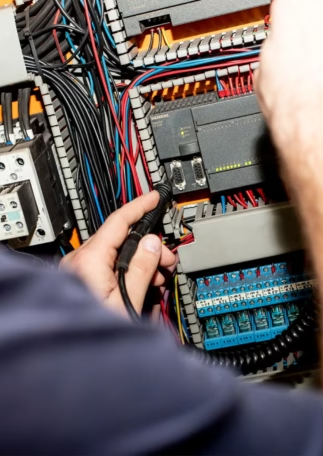
If there is no visible damage to a motor capacitor, you can test its continuity to rule out a defect. However, the same warning applies here: Danger—risk of death! To be on the safe side, have this task performed by a trained electrician.
Before a capacitor can be tested, it must be disconnected from the auxiliary winding—that is, removed from the motor. Once this is done, you must ensure that the motor capacitor is discharged. Otherwise, not only is there a risk that the component could damage the electronics of a testing device, but there is also a danger of a very serious electric shock, which can sometimes be fatal.
Not all measuring devices are suitable
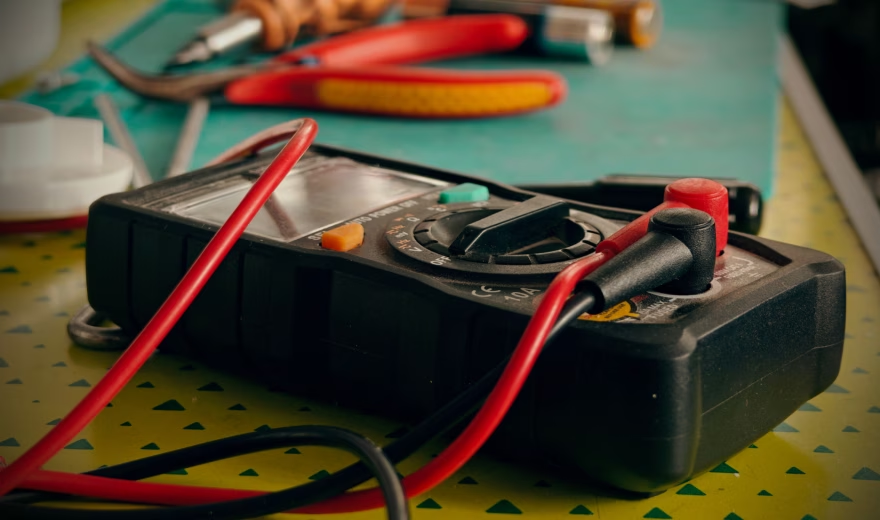
Not all measuring instruments are suitable for testing a motor capacitor. Digital multimeters, for example, are completely unsuitable. Simple analog devices, on the other hand, generally serve their purpose. However, the test voltage of most devices is not sufficient to provide reliable absolute values. The test is only approximate and can, at best, indicate whether the component is defective.
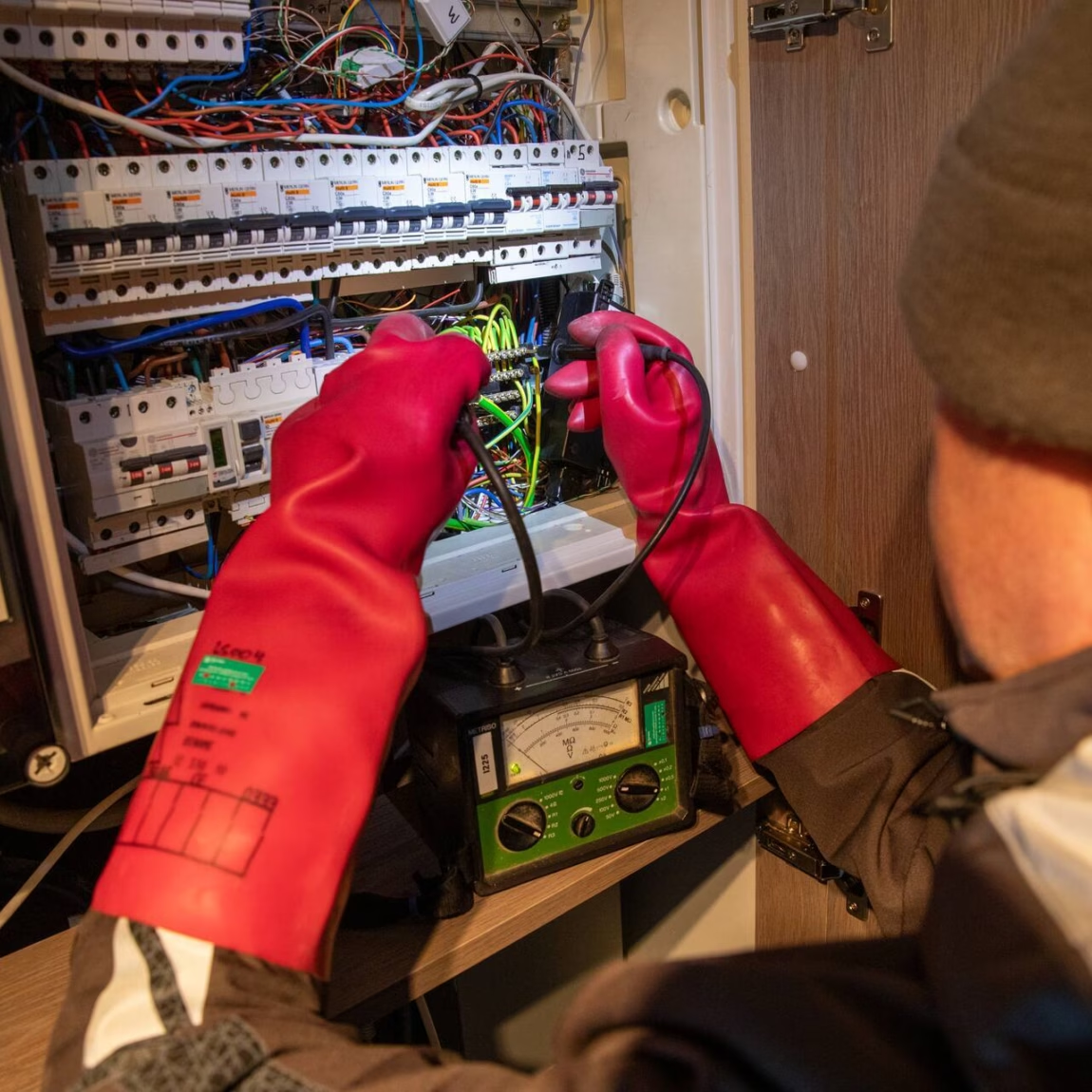
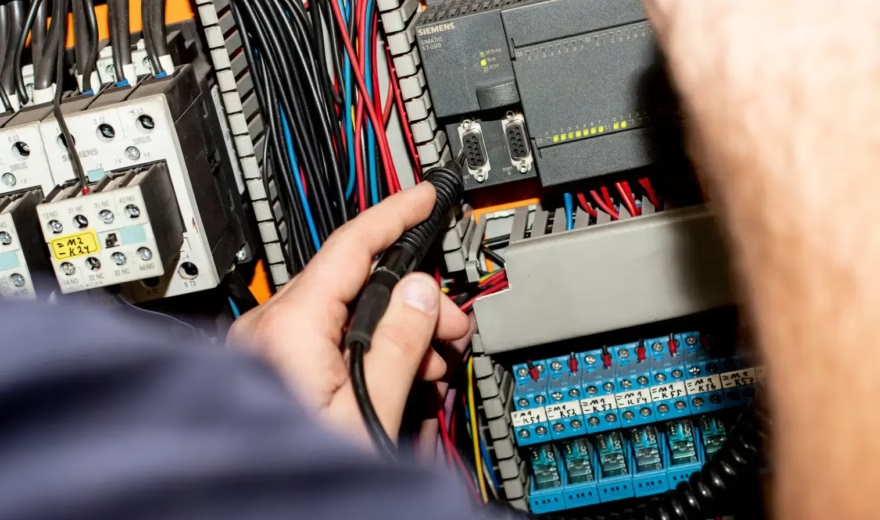
To measure a discharged and removed capacitor, set the meter to the continuity test mode. Place the test probes on the two contacts. If there are four contacts, two of them are always connected to each other—from an electrical standpoint, capacitors have only two terminals. It is important not to touch the contacts with your fingers during the measurement, as the resistance of your body would distort the result.
During the continuity test, the pointer of the analog meter should first swing all the way to the right and then slowly return to the zero position. The capacitor builds up an electrical potential in the DC circuit, which is powered by the meter’s battery. Proportional to this, the current decreases until it finally drops to zero when the functioning capacitor reaches its maximum capacitance.
For small capacitances, the initial needle deflection may be very slight. If the needle remains at the right-hand end, the capacitor is not storing any energy and is likely defective. If there is no deflection at all, a defect is also likely present.
Testing the Motor Capacitor with an Ohmmeter
You can also test the capacitor in an electric motor by measuring resistance with an ohmmeter. During this measurement, the resistance should start low and gradually increase as the capacitor charges.
For both measurement methods, the most meaningful comparison is with a motor capacitor of the same technical specifications that is known to be functioning properly. If the needle deflections are similar in intensity and over time, the capacitor is likely in good working order.
However, to measure the capacitance of a capacitor—which may have decreased over time—you need a special capacitance meter that displays the value in farads, the unit of capacitance.
What exactly does the capacitor do in an electric motor?
The term “motor capacitor” encompasses two different types of capacitors: the operating capacitor and the starting capacitor. Almost all capacitor-start motors have an operating capacitor. Only the electric motors of some specialized machines also have a starting capacitor. This second capacitor is necessary, for example, in machines that are very heavy or have to operate under high pressure. Furthermore, electric motors often contain a noise-suppression capacitor; however, this has nothing to do with the motor’s actual function and will therefore not be discussed here.
The Operating Capacitor
In most electric motors, a rotating element—the rotor—moves within an electromagnetic field generated in the stationary part of the motor, the stator. To produce a directed rotational motion, the electromagnetic field must exhibit dynamics that generate torque. In motors powered by standard 230-volt household alternating current, this requires current to flow in two different phases through two separate copper windings in the stator: the main winding and the auxiliary winding.
However, the available AC power provides only one defined phase. It is routed through the main winding. The operating capacitor connected in series is responsible for the 90-degree phase shift of the current flowing through the auxiliary winding. This phase shift is caused by the electrical behavior of the capacitor in the AC circuit. The capacitance of a capacitor for this application in a “single-phase motor” is typically between 25 and 30 µF (microfarads) per kW of motor power, but depends on many different factors.
In addition, there are so-called three-phase motors with a Steinmetz circuit, which can be operated on both a standard AC power grid and with three-phase high-voltage current. The capacitance of the running capacitor in such motors is approximately 70 µF per kW of motor power. Running capacitors are constantly in the circuit during so-called continuous operation.
The starting capacitor
Motors in machines that must start against high resistance—such as floor grinders or compressors—also have a starting capacitor. This capacitor has a high capacitance and is active only during the motor’s starting phase. Afterward, shut-off mechanisms such as centrifugal switches ensure that the capacitor is disconnected from the circuit. If this does not happen, these capacitors—which are not suitable for continuous operation—can burn out. Their purpose is to provide the motor with a particularly strong starting torque—essentially a push to get it going. Under no circumstances should starting capacitors be installed as operating capacitors, as they are not designed for continuous operation.
There are also motors that have only one starting capacitor—meaning they only need a “nudge” to start and can generate torque during operation without a capacitor. However, these are rarely used.
Where can I find all the information about the capacitor, and what do the specifications mean?
In most cases, all the information about the capacitor is printed on the component itself. This includes, for example, the capacitance in microfarads (µF) and the tolerance in +/- percent. It also lists the rated voltage in volts (V) and a service life class in hours (h). However, a capacitor’s service life always depends on external factors, such as the ambient temperature.
The abbreviations AB or DB indicate the operating mode. AB stands for intermittent operation and identifies starting capacitors that are not suitable for continuous operation (DB). Operating capacitors are accordingly marked with a DB.
Furthermore, the capacitor should bear the appropriate certification marks and manufacturer information. If this information is not present on the component itself, it is likely to be found on the motor’s nameplate or on a separate label near the capacitor cover. If necessary, consult the motor’s documentation. The manufacturer’s website or hotline is also a possible source if you are missing information.
If I can’t find any specifications, can I calculate them?
Theoretically, yes. As a rough rule of thumb—though it is very imprecise—the following applies: for a single-phase motor, 5 µF of capacitance per 100 watts of motor power; for a three-phase motor with a Steinmetz circuit, 7 µF per 100 watts. In addition, there are calculation methods that are approximately dependent on torque, the motor’s design, and the number of turns in the main and auxiliary windings—and these must be determined empirically through measurement for each specific motor type.
Professional maintenance saves costs in the long term
Well-maintained motors play a crucial role in preventing malfunctions in industrial plants. Last but not least, professional maintenance also reduces the likelihood of failures during the DGUV V3 inspection. The experts at GP Prüfservice GmbH have many years of experience not only in inspecting electrical systems and electrical equipment but also in providing industrial services. Contact us if you’d like to entrust your electrical inspections to experts. We’d be happy to advise you!