In recent years, modern information technology has made great strides in German manufacturing facilities. Industry 4.0—as the use of intelligent and digitally networked systems in industrial facilities is often called—has also ushered in a transformation in industrial services. More and more companies are reorienting their approaches: they are adopting new maintenance strategies. Instead of relying on traditional reactive maintenance, they are turning to preventive maintenance, condition-based maintenance, or predictive maintenance to minimize downtime and reduce costs.
In this blog post, the experts at GP Prüfservice explain the advantages of the various maintenance strategies and how they interact with electrical inspections such as the DGUV V3 inspection.
Contents of this article
- The Interplay Between Maintenance Strategies and Electrical Inspections
- Maintenance Strategies at a Glance
- Reactive Maintenance – Repairs When a Failure Occurs
- Preventive Maintenance—Caution: High Costs!
- Condition-Based Maintenance—Only What’s Really Necessary
- Predictive Maintenance – Looking to the Future
- Frequently Asked Questions
The Interplay Between Maintenance Strategies and Electrical Inspections
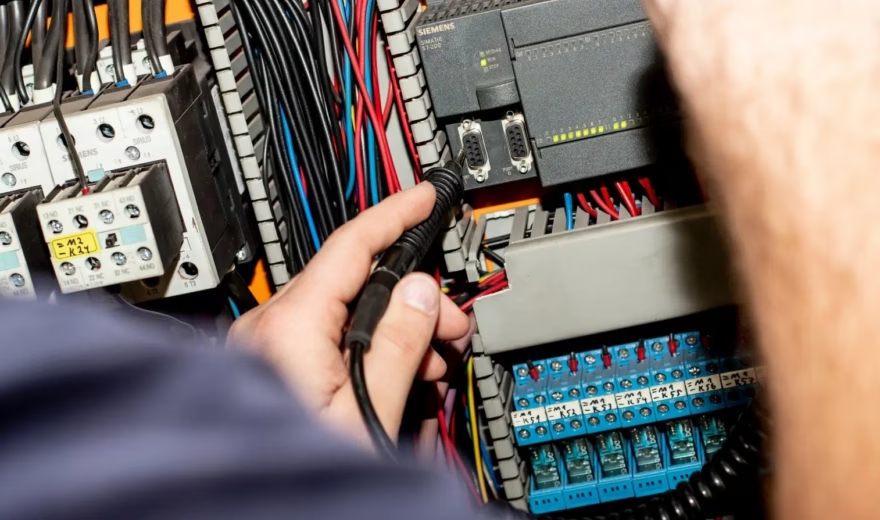
Modern maintenance strategies and electrical inspections are two components that work seamlessly together to ensure operational safety and efficiency in your company. But how exactly do these two elements complement each other and add value to your operations?
Maintenance strategies are designed to maximize the efficiency and service life of your machinery and electrical equipment. The goal is to use proactive measures to detect potential malfunctions and breakdowns early on, before they impact productivity. This is achieved through regular inspections, maintenance, and preventive measures.
On the other hand, electrical inspections play a crucial role in ensuring electrical safety. They serve to ensure compliance with legal regulations governed by DGUV V3. They also help ensure the safety of your employees.
When we combine these two components, a synergy emerges that goes far beyond the individual benefits. With an optimally coordinated maintenance strategy, electrical inspections can be effectively integrated into day-to-day operations, thereby minimizing disruptions and improving operational efficiency. Potential risks and downtime are effectively reduced.
Wondering which maintenance strategy is right for your industrial company? Then you’ll find plenty of helpful information in this blog post. The experts at GP Prüfservice GmbH explain the pros and cons of the different approaches. We draw on decades of experience in industrial services and would be happy to advise you on how to efficiently integrate our electrical inspections into your company’s current or future maintenance strategy. Give us a call!
Smart Maintenance Reduces Costs in Industry
In the past, it was common practice to repair industrial equipment only after it had broken down. Nowadays, many companies are shifting toward performing regular, preventive maintenance on their machinery. The term “predictive maintenance” is also becoming increasingly common—a concept that heralds a paradigm shift in Industry 4.0. It is no longer a matter of identifying defects during maintenance and reacting to them, but rather of detecting potential problems in advance. Monitoring—that is, the continuous surveillance of machines using measurement technology—is therefore a cornerstone of modern maintenance.
An Overview of Various Maintenance Strategies
Condition-based, predictive, preventive—for the layperson, these terms can quickly become confusing. Let’s therefore take a look at the differences between modern maintenance strategies.
First, it’s important to emphasize: There is no universal rule determining which maintenance strategy is right for which company. The right maintenance strategy always depends on individual circumstances. Often, a combination of several strategies is the most effective approach. As a business owner or plant manager, you should therefore carefully analyze your needs and then choose which maintenance strategies best suit your facilities.
As already mentioned, the possible maintenance strategies are divided into reactive, preventive, condition-based, and predictive maintenance. Before we discuss these four approaches in detail in the following chapters, here are the key points at a glance
- Reactive maintenance is the traditional approach, in which machines and equipment are repaired when problems arise. This strategy is now considered outdated.
- In preventive maintenance, the machine is serviced at set intervals.
- In condition-based maintenance, the machine’s actual current condition is continuously monitored, and maintenance is adjusted accordingly. This strategy is suitable for the maintenance of many modern industrial systems. Initially, this approach proved to be very complex and costly. However, intelligent solutions have long since become available that are easy to implement thanks to sophisticated sensor technology and also help reduce costs.
- Predictive maintenance takes this a step further. Here, too, the entire plant is continuously monitored using measurement technology. In addition, complex analyses ensure that problems can be predicted before they occur. Predictive maintenance essentially predicts the future, thereby enabling even better maintenance planning.
As a business owner, you can choose one of the four strategies or select a combination tailored to your equipment, its age, and the individual equipment components. Compliance with legal requirements and adherence to the manufacturer’s recommendations play a decisive role in all maintenance strategies and remain important even in the age of Industry 4.0.
Reactive Maintenance—Repair Upon Failure
Reactive maintenance is a strategy that was common practice in the past. Repairs were performed only when defects or wear were detected during routine maintenance or electrical inspections, or when machines and equipment failed due to defects. Many companies still use this maintenance method today, even though reactive maintenance has been shown to result in additional costs and higher financial expenses for repairs.
If a defect is detected or a piece of equipment shows signs of wear and tear, the business owner reacts by having the affected part replaced. Unfortunately, this method very often leads to equipment suddenly breaking down and remaining out of service for an extended period—for example, because a replacement part is missing. This presents industrial companies with the problem that they cannot fully utilize their resources and must expect financial losses. In Industry 4.0, the reactive aspect of maintenance strategies is becoming increasingly less important. When a defect occurs, repairs are of course still carried out. However, the goal is to prevent it from happening in the first place.
Preventive Maintenance—Beware: High Costs!
Preventive maintenance measures are based on predetermined time intervals, which are generally determined by the operating times of the machines and equipment. To carry out preventive maintenance measures, the equipment is regularly shut down and inspected for wear, defective components, material weaknesses, and functional limitations. Preventive maintenance does have the advantage of preventing some defects. However, it is not uncommon for components that are still functional to be replaced, and for the remaining service life of existing components not to be fully utilized. As a business owner, you must therefore expect enormous additional costs. You are spending money on unnecessary repairs.
Preventive inspections thus increase the service life and availability of industrial equipment, but the cost in this case is very high. When combined with other measures, preventive maintenance can certainly be an appropriate approach. Viewed in isolation, however, preventive maintenance is no longer considered state-of-the-art.
Condition-based maintenance—only what’s truly necessary
Condition-based maintenance is a modern strategy that allows you to make the most of your resources while saving costs. Among the available maintenance strategies, condition-based measures are becoming increasingly important and are a key component of Industry 4.0. The goal of condition-based maintenance is to plan and implement necessary maintenance measures in a way that is optimal in terms of timing, quality, and cost.
But how does condition-based maintenance work? With state-of-the-art measurement technology, it is now easily possible to precisely record and evaluate the current condition of your plants and machines. Monitoring plays an extremely important role here. After all, only when you have precise information about the condition of all components can you ensure maximum efficiency while simultaneously protecting yourself against breakdowns. The advantage over preventive maintenance: A piece of equipment is replaced only when it is truly worn out—and not simply because a maintenance schedule calls for it.
The reverse is also true: If a component shows more signs of wear than expected, it is replaced in a timely manner—not just when it is due according to a scheduled rotation. Thanks to the measurement results described and evaluated, you can identify the causes of a potential malfunction or impending equipment damage in advance and have the opportunity to act proactively and initiate measures to address defects expected in the future. In doing so, you make full use of the wear allowance and prevent primary damage, thereby generally avoiding costly consequential damage and the associated downtime.
There are various analytical methods, such as vibration analysis, that allow imminent damage to be detected early and addressed accordingly. Condition monitoring is used to monitor the condition of equipment and serves to record and evaluate the current state of plants and machinery. Condition-based maintenance does not require interrupting ongoing operations, as monitoring is possible while equipment is in operation—thanks to sophisticated measurement technology. Continuous condition monitoring offers enormous advantages in terms of safety, availability, and efficiency for all technical systems and industrial machinery.
Predictive Maintenance—A Look into the Future
In predictive maintenance, as with condition-based maintenance, all components of an industrial plant are continuously monitored using sensitive measurement technology. Predictive maintenance, however, goes one step further. Through intelligent analysis of a wide variety of data, it becomes possible, so to speak, to look into the future. Maintenance is then tailored to what is most likely to happen.
The data collected consists of various parameters and comes from different sources. For example, in addition to the measured values, manufacturer data is also taken into account. Data mining and continuous analysis make it possible to identify even highly complex relationships. The system provides precise results regarding the probability of failure and issues a forecast of which maintenance measures are necessary.
The major advantage of predictive maintenance: When your company relies on predictive maintenance, unplanned events become a thing of the past. You can reliably calculate your budget for maintaining your machines and equipment while still being able to respond flexibly. For example, by repairing components at high risk of failure while temporarily suspending less critical maintenance tasks.
What is required to implement predictive maintenance?
The concept of predictive maintenance is based on equipping machines and systems with modern sensor technology. Ultrasound plays a leading role in the technologies behind smart maintenance strategies. With ultrasound, it’s possible to detect impending failures in a timely manner and predict the likelihood of a failure in the foreseeable future.
Strong Arguments for Preventive Maintenance
It has long been known that reactive maintenance is considered an outdated approach. However, preventive maintenance has also become obsolete in an increasing number of industrial facilities, as it often involves the unnecessary replacement of functioning components, thereby incurring high costs. Only through condition-based or predictive maintenance measures can companies make optimal use of their existing resources and fully realize their potential.
- Since primary damage is detected early on, you can generally prevent secondary damage and thus operate more economically.
- You increase safety for your employees and the environment.
- The collected data allows you to assess the quality of your products.
- You are always informed about the current condition of your systems and machines.
- You avoid unnecessary repairs and disassemblies.
- You do not need to keep large quantities of spare parts on hand. The monitoring system alerts you in a timely manner so that necessary parts can be ordered.
- You can plan your equipment’s downtime precisely.
Save Money with Condition-Based Maintenance
With condition-based maintenance measures, you can reduce your costs by an average of 15 to 23 percent. You also reduce production downtime by 16 to 36 percent and equipment downtime by 20 to 35 percent.
Summary: Maintenance Strategies of the Future—What Matters Most
Modern maintenance strategies enable industrial companies to detect problems in production equipment early on while simultaneously reducing maintenance costs. Instead of merely repairing equipment after it breaks down (high risk of downtime) or relying solely on preventive maintenance (high costs), they monitor their equipment using sensitive measurement technology and carry out maintenance measures at the optimal time.
A combination of different maintenance strategies is nevertheless effective, as the selection of the right strategy should always be tailored to the individual components of the systems and machines. In principle, predictive maintenance strategies are effective for large, medium-sized, and small industrial companies. However, not every strategy is suitable for every company.
Frequently Asked Questions About Maintenance Strategies
How is maintenance defined?
The term “maintenance” is defined and structured in the DIN standards DIN 31051 and DIN EN 13306. The term encompasses all measures that ensure that a so-called “unit of consideration” remains functional or is restored to functionality. Maintenance measures include servicing, inspection, repair, and improvement.
What is a unit of consideration?
An “unit of consideration” is a very general and variable term referring to the equipment or facility that is to be maintained or repaired.
What is the difference between condition-based and predictive maintenance?
In condition-based maintenance, continuous condition analysis using modern measurement technology ensures that the component’s wear allowance is utilized optimally. Predictive maintenance goes a step further and uses empirical data and probability calculations to determine in advance when a maintenance action is due. In addition to condition analysis, it also looks ahead to the future. If downtime can be planned for and minimized in advance, this contributes to lower maintenance costs.
What is a wear reserve?
With continuous condition monitoring, a wear part generally does not fail overnight but wears down gradually. In this context, the wear reserve refers to the margin a component or piece of equipment has before it causes a malfunction. Ideally, maintenance should be performed only when the wear margin is almost completely exhausted—but not so late as to prevent primary and consequential damage.