Structure: An electric motor consists of these parts
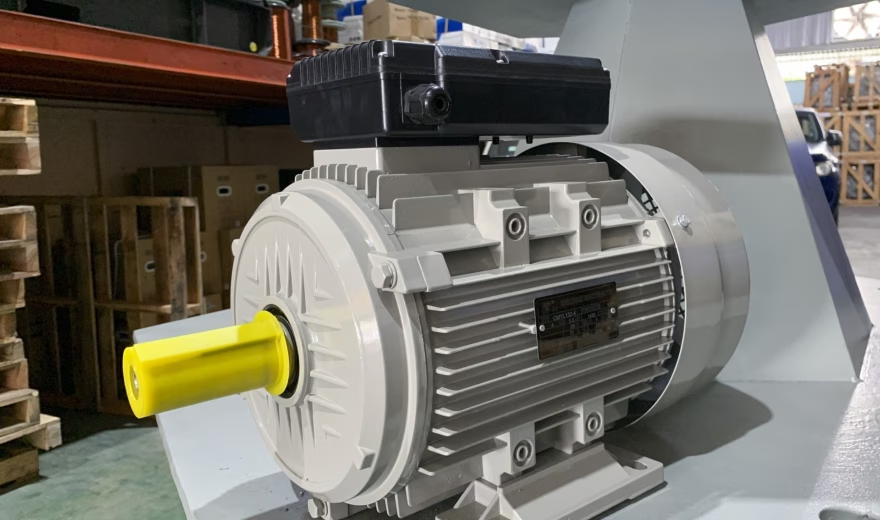
We’ve already touched on a few technical terms related to electric motors above. In this chapter, we’ll take a closer look at the individual components of an electric motor.
Stator
The stator is the stationary part of the electric motor. Depending on the motor type, either a permanent magnet or an electromagnet is used here. In most motors, the stator is located on the outside and is connected to the housing. However, there are also motors in which the stationary part is located on the inside and the rotor rotates around the stator. In this case, the motor is referred to as an external rotor motor.
Rotor
The moving part of an electric motor is called the rotor, armature, or running element. In most cases, the rotor consists of a shaft and a coil of enameled copper wire through which current flows, turning the rotor into an electromagnet.
Armature
“Armature” is often used as a synonym for “rotor,” but in a stricter sense, it describes the iron core of the rotor around which the coils are wound.
Commutator
The commutator takes its name from the Latin word commutare (meaning “to exchange”) and is responsible for reversing the direction of the current. It is therefore often referred to as a current reverser. As the current direction changes, so does the magnetic field of the electromagnet. This is necessary to prevent the motor from stopping. In many cases, the commutator is a metal disc divided into two segments that are insulated from one another and that rotates with the motor’s shaft. Power is usually supplied by carbon brushes that are pressed against the commutator. After half a revolution of the motor, the power supply is briefly interrupted, and then the current flows in the opposite direction through the coil. The following animation illustrates this principle:

Source: MichaelFrey (Own work) https://web.archive.org/web/20210724051701/ https://creativecommons.org/licenses/by-sa/3.0
Power Source
No electric motor can function without an electromagnet. Therefore, every electric motor must have a power source that turns the otherwise non-magnetic rotor into an electromagnet.
Brush
Brushes, which are often made of graphite, supply current to the rotor via the commutator.
Capacitor
A capacitor stores energy and releases it as needed. Many electric motors have operating capacitors that ensure the motor starts, rotates in the correct direction, and delivers power smoothly. Very large machines may also have a starting capacitor. The capacitors are often mounted on the outside of the motor housing. They are relatively inexpensive wear parts and are frequently the cause when an electric motor fails to start.
Different Types
There are quite a few different types of electric motors. Listing all of them would go beyond the scope of this blog post. However, we’d like to briefly introduce at least the most important types of electric motors here. Broadly speaking, electric motors are divided into two classes: direct current (DC) motors and alternating current (AC) motors.
Direct-Current Motor (also called a commutator motor)
DC motors—as the name suggests—are powered by direct current. They therefore rely on the commutator mentioned above to function. This mechanical inverter ensures that the current automatically reverses polarity with every half-revolution of the shaft.
DC motors are further divided into two subclasses: permanently magnetized motors and electrically excited motors. In a permanently excited DC motor, the stator is a permanent magnet and only the rotor is an electromagnet. This design is used, for example, in fans and automotive starters.
In an electrically excited DC motor, both main components are electromagnets. Here, a further distinction is made between series-wound or shunt motors on the one hand and shunt-wound motors on the other. The difference: In a shunt-wound motor, the stator and rotor each have their own power source. A series-wound motor has only one power source. These motors can also be operated with alternating current and are therefore known as universal motors. Electrically excited DC motors are used in many household appliances.
AC and Three-Phase Motors
Things get even more complicated with three-phase motors. A three-phase motor is powered by three-phase alternating current, which is also referred to as three-phase power or, colloquially, high-voltage current. The stator of these motors consists of three coils, each fed by one phase of the three-phase current. The three phases of the alternating current are phase-shifted by 120 degrees relative to one another. The magnetic field, which is offset by one-third of a cycle, causes the rotor to rotate.
Three-phase motors are also divided into two subclasses: synchronous and asynchronous machines. In asynchronous machines, the rotor’s frequency lags behind that of the magnetic field. In synchronous machines, the frequencies of the rotor and the magnetic field are identical. What may sound like a minor detail makes a huge difference in practice. Synchronous motors are significantly more efficient and can achieve an efficiency of up to 90%. However, they are also more expensive to manufacture, and their operation requires extensive maintenance. For this reason, they are rarely used—for example, in compressors, marine propulsion systems, or shredders. They are used somewhat more frequently as generators—that is, in the reverse scenario, where mechanical energy is to be converted into electrical energy.
The situation is quite different with asynchronous motors: This type of motor is inexpensive and considered very robust. It is therefore no coincidence that three-phase asynchronous motors are by far the most widely used electric motors. It is estimated that approximately 80% of all energy consumed by electric motors worldwide is accounted for by asynchronous motors. They are used in nearly all industrial sectors, for example, as drives in machine tools, fans, pumps, or conveyor belts.
There are also further subcategories of three-phase machines, which we will not discuss in detail here. The following diagram summarizes the most important types.

Source: https://web.archive.org/web/20210724051701/https://creativecommons.org/licenses/by-sa/4.0 https://web.archive.org/web/20210724051701/ https://commons.wikimedia.org/wiki/File%3ASystem_Drehstrommaschinen_de.svg via Wikimedia Commons
Applications
The applications of electric motors are extremely diverse. Hardly any modern achievement would be conceivable without electric motors. The spectrum ranges from small fans that cool computers or provide fresh air in cars, to washing machines, to industrial motors or marine engines with outputs of many megawatts. In the following chapters, we’ll present some examples from the industrial and mobility sectors.
Industrial Applications
The applications of electric motors in industry are divided into twelve categories. They all have different requirements—which is why different types of motors are used.
- Conveyor belt drives (robust and reliable—continuous operation).
- Drives for material-handling vehicles (high precision).
- Drives for cranes, construction elevators, or other lifting devices.
- Positioning drives used, for example, to transport individual components to their destination.
- Drives for industrial robots.
- Synchronous drives, for example, for rolling or printing.
- Drives for winding and unwinding, such as steel sheet or paper (special requirement here: the speed must be constantly adjusted to the circumference of the roll).
- Indexing drives for cross-cutters or flying saws (the material moves during the cut).
- Drives with non-uniform motion, such as those used in punching.
- Drives for forming processes, such as pressing.
- Tool drives, such as for drilling, milling, or grinding.
- Drives for fans or pumps.
The Efficiency of Electric Motors in Industry
Over the past few decades, environmental concerns have led to ever-higher efficiency requirements for electrical appliances, and not just in the residential sector. Low-voltage three-phase induction motors—typically used in industrial applications—also have their own efficiency classes. Whereas refrigerators are rated on a scale from G to A (best), low-voltage three-phase induction motors in the power range from 0.75 kW to 375 kW are rated on a scale from IE1 to IE4 (best). Since 2011, the sale of motors with the standard efficiency of Class IE1 has been restricted.
Electric Mobility
Even though it feels like electric cars and e-bikes have only been on everyone’s lips for a few years—the history of electric mobility dates back to the 19th century. It caught on very quickly in trains and streetcars. For other modes of transportation, such as cars and bicycles, it took more than 100 years before the technology truly made its breakthrough.
In Cars
When the automobile was still in its infancy, the question of which type of propulsion would eventually become the standard was by no means decided so quickly in favor of the internal combustion engine as one might think today. In 1888, the A. Flocken Machine Factory built the first four-wheeled electric passenger car in Germany. In 1900, 40% of all cars in the U.S. were steam-powered, 38% were electric, and only 22% ran on gasoline. But the electric car soon became a niche product. The delicate batteries and much shorter range were major drawbacks of the electric car, which worked in favor of the internal combustion engine. The electric motor was then used only in auxiliary components, such as the interior ventilation system or the starter motor.
New developments in battery technology and advances in environmental protection brought the topic back onto the agenda in the 1990s. But it wasn’t until the U.S. company Tesla unveiled its Roadster in 2006 that the electric car market finally gained momentum. Today, nearly all major manufacturers offer fully electric cars or at least plug-in hybrids. The electric car began its triumphant advance in the early 2020s. Since the phase-out of internal combustion engines in new vehicles has now been decided, electric cars will soon have replaced gasoline and diesel vehicles.
What type of electric motor is used in a car?
There are various concepts that can be used to power an electric car, such as inverter-controlled synchronous and asynchronous motors, as well as direct-current motors. When the BMW i3—one of the first German production vehicles with a purely electric motor—was launched, it was powered by a 170 PS hybrid synchronous motor in the rear. In VW’s first all-electric e-Golf, a 115 PS permanent-magnet-excited synchronous motor did the job. The Renault Zoe compact car has a separately excited three-phase synchronous motor with a maximum output of 92 PS. Even among modern electric cars, which are becoming increasingly powerful, there are still differences in drive concepts. The Audi E-Tron S is equipped with three asynchronous motors. Depending on the model, the Porsche Taycan uses one or two permanently excited synchronous motors. And BMW is bringing a self-excited synchronous motor (SSM) to the road in the iX3 and iX.
In Trains
Unlike in private transportation, the advantages of electric motors were recognized early on in public transit. Because tracks and overhead lines can be electrified, trains, subways, and streetcars do not suffer from the disadvantage of limited range. This is because electricity is always available for railways; there is no need for temperamental batteries. The immense potential of electric motors in trains became clear as early as the beginning of the 20th century. In 1903, experimental electric railcars from Siemens and AEG both broke the 200 kilometers per hour top speed barrier. Today, the world speed record for rail vehicles stands at more than 570 km/h, set by an experimental vehicle based on the TGV.
What kinds of motors power the ICE?
The various models of Deutsche Bahn’s InterCity Express (ICE) series utilize different propulsion systems and motors. A 200-meter-long ICE 3 high-speed train, for example, has a total of 16 traction motors distributed throughout the entire train. A single one of these three-phase asynchronous motors delivers a maximum power output of 500 kilowatts. The entire train therefore has a total power output of 8,000 kilowatts, which is more than 10,800 PS.
In E-Bikes
The first bicycles with electric assistance appeared as early as the 19th century. However, e-bikes and pedelecs have only recently become truly popular. Ongoing advancements, particularly in battery technology, have made the electric bicycle an attractive mode of transportation for an ever-growing number of people. The market share in 2016 was around 15 percent; the trend is clearly upward.
There are various drive concepts for bicycles with electric motors. Strictly speaking, an e-bike is a bicycle in which the motor operates even without the rider’s input. In contrast, the motor on a pedelec only activates when the rider pedals—the motor thus provides only assistance. In common parlance, however, the term “e-bike” is often used for both types. The motor is either located in the wheels (hub motor) or mounted centrally on the bike (mid-drive motor). At least regarding the type of electric motor used, the industry has now largely reached a consensus. Almost exclusively, permanent-magnet-excited DC motors without slip rings are now used.
In ships
Ships powered exclusively by electric motors are still the absolute exception. In Norway, the world’s first all-electric ferry was unveiled in 2013. However, anyone who thinks that almost all modern ships are powered exclusively by internal combustion engines is mistaken. Integrated electric propulsion systems are also common. In these systems, electric motors provide the actual propulsion, while diesel- or gas-powered generators produce the necessary electricity. Prominent examples of this category are the transatlantic liners Queen Elizabeth 2 and Queen Mary 2. The Queen Elizabeth 2 was converted to a diesel-electric propulsion system in 1986, in which two electric motors, each delivering 44 megawatts of power, drive the propellers. The Queen Mary 2 has four electric motors and boasts a total engine power of 86 megawatts. The electricity is generated by four diesel engines and two gas turbines with a combined output of 126 megawatts.
Electric Motor vs. Internal Combustion Engine
There are numerous areas of life in which electric motors have largely—or even completely—replaced internal combustion engines. And that time is fast approaching in the realm of mobility as well. Volvo, the first major automaker, announced years ago its intention to transition entirely to electric motors in the medium term. It is now a legal requirement across the EU that no new internal combustion engine vehicles will be registered starting in 2035. So it’s high time to compare the pros and cons of electric motors and internal combustion engines.
Simpler Design: An internal combustion engine is significantly more complex than a comparable electric motor. While a typical passenger car engine today consists of about 1,400 individual parts, a comparable electric motor requires only 1,000 individual parts. The less complex an engine is, the less prone it generally is to malfunctions and the more cost-effective its maintenance.
Lightweight: An electric motor is significantly lighter than an internal combustion engine. For the same power output, a gasoline engine is about four times as heavy. However, this applies only to the motor itself; the advantage is negated by the heavy batteries (see below: Energy Density).
Power Delivery: Aclear advantage for the electric motor. An electric motor can deliver its full torque shortly after starting. An internal combustion engine typically requires a specific RPM to reach maximum torque; to get as close as possible to this value during operation, the RPM is adjusted via a transmission. With an electric motor, a transmission is not needed in most cases.
Less Noise: In addition to the advantage that no pollutants are emitted when operating an electric car (though these are generated earlier during electricity production), the electric motor has the advantage of being significantly quieter.
Low energy density: Perhapsthe biggest disadvantage of the electric motor is the low energy density of the batteries. These energy storage devices fall far short of the energy density of gasoline or diesel. As a result, a large number of batteries are required to achieve a range that at least comes close to that of an internal combustion engine. The batteries are heavy; the advantage of low weight is thus a thing of the past.
Weak infrastructure: When it comes to refueling, the electric car still comes up short. Although the infrastructure is being continuously expanded, if all cars were to switch to charging overnight, absolute chaos would ensue. Because the charging process for an electric car—fast chargers or not—takes significantly longer than filling up with 50 liters of gasoline or diesel, significantly more charging stations would likely be needed than there are gas pumps today. Otherwise, supply would not be guaranteed, at least during typical travel periods (such as the start of vacation season). So far, however, the expansion of the charging network has kept pace with the growth in new registrations, and electric car drivers generally don’t have to worry about finding a spot at a charging station.
Heating Reduces Range: It’sactually an advantage that an electric motor generates hardly any waste heat (see below: Energy Balance); in winter, however, the downsides become apparent. Because the motor doesn’t heat the interior, electricity must be used for heating. Using the heater therefore reduces the electric car’s range.
Efficiency and Environmental Impact: The energy balance of electric cars is significantly better than that of a car with an internal combustion engine—despite the resource-intensive production of battery cells. Over its entire life cycle, an electric car emits at least 30% less CO2. At first glance, the electric motor even has a huge advantage: 90% of the energy used is converted into motion; with an internal combustion engine, it’s only 30%, with the rest lost as heat and friction. However, there are two things to keep in mind: An electric motor is only as environmentally friendly as the source of its electricity. If the electricity comes from coal-fired power plants, the electric motor loses out. Naturally, the more clean or renewable energy sources that are used, the better the electric motor performs. A great deal of energy is also required to produce the batteries. And here, too, the type of energy source plays a decisive role in determining the electric car’s environmental footprint.
Diagnosis and Repair
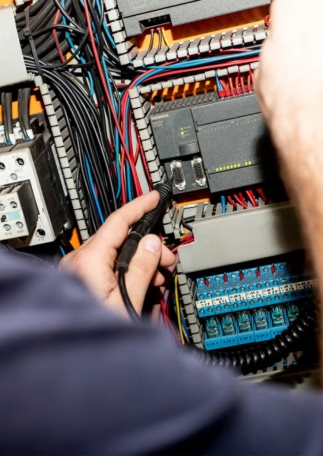
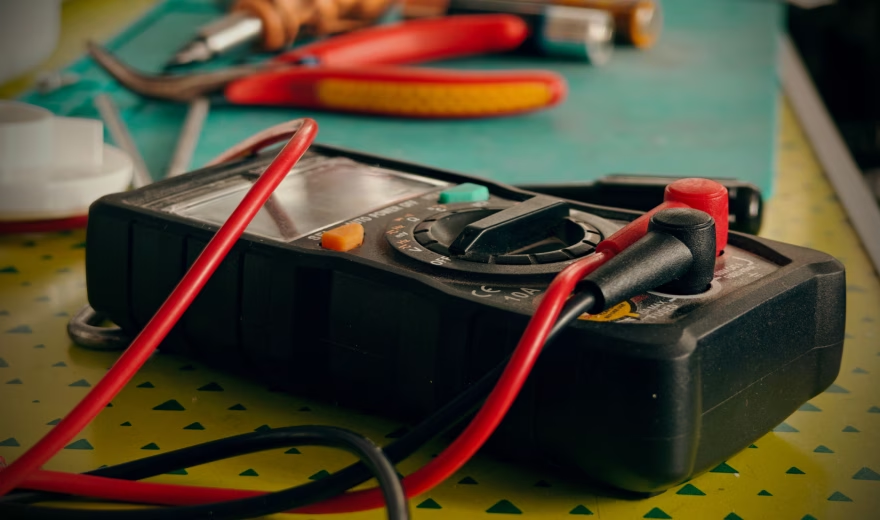
After covering many general aspects of electric motors in the previous chapters, we will now focus on the topic of troubleshooting and repairing electric motors. Since we’ve already covered this topic in detail in other blog posts, we won’t go into detail here but will simply refer you to our other articles. If you need tips on troubleshooting electric motors, you’ll find them in the following posts:
Maintenance
To prevent malfunctions from occurring in the first place, professional maintenance of electric motors is essential. However, scheduled maintenance is rarely recommended these days because it often involves replacing components that are still in good working order, resulting in unnecessarily high costs. The experts at GP Prüfservice GmbH know from their many years of experience in industrial services that condition-based—or, ideally, predictive—maintenance is the best approach.